4 teammates

5 weeks
The project was carried out during the course Design Studio II, in my second year at Halmstad University. The assignment came from the administration at Halmstad with the aim of evaluating whether the support provided to the university's management and executives today is adequate. In 2024, an inventory of existing services within the area of leadership support was conducted, but despite the complex ecosystem no mapping of the actual experiences has been made. By using thorough qualitative and quantitative data collection, I aimed to understand whether the support is sufficient, how accessible it is, where responsibilities overlap and what creates friction in daily work.
My role in this project was not defined and has been flexible thoughtout multiple steps of the process. However, I was especially focused on the qualitative data collection and analysis. I am confident in my role as an interviewer and had great practice collecting valuable insights ad translating these into tangible pain points and design opportunities.
* Note that the project was conducted in Swedish
Delivery: Three key improvement areas with actionable steps forward
- Fragmented communication and unclear responsibilities within the organization.
- Difficulty in aligning support services with diverse leadership needs and expectations.
- Inefficient digital systems that slow down workflows and collaboration.
- Conducted qualitative and quantitative research to map pain points.
- Developed user-centered design solutions to streamline processes and improve information flow.
- Delivered 3 clear problem areas with concrete next steps for improvement.
- Predicted future challenges and opportunities to proactively guide leadership support services.
- I've gained a deeper understanding of working with more affected stakeholders, as their needs and influences significantly shape design decisions and outcomes.
- Prototypes may involve service journeys, workflows or policies and I now have a better apprehension of how a solution can be presented beyond just UI elements.
- If I had the chance to re-do this project, I would have prioritized differently, with more time for impact analysis rather than present state analysis. It would be really interesting how the results would change.
Support for the leadership and managers at Halmstad University is provided by the departments within the operational support units (HR, finance, IT, communication, legal etc) and by support at the acadamies. The target group consists of executives within the university’s top management, academy leadership teams, department heads at the academies and staff within the operational support units. Some are employed as managers, while others hold temporary leadership assignments.

* Organizational chart for an overview of how leadership roles and operational units are distributed across the institution

* "Bubble map" to understand each role. The map includes job responsibilities which are marked: Green = continuous support, Yellow = only if required.
Both qualitative and quantitative methods were used to gain a comprehensive picture of the current situation. Desktop research was also conducted to map departments, roles and hierarchy, providing a clear overview of the organization's structure and distribution of responsibilities.


Insights:
- Lack of communication between departments and academies.- Flaws in physical work enviorment
- Lack of information
- Stress and work overload amongst both workers and management.
The observations primarily informed the development of the interview guide and survey, providing a contextual understanding of different roles, their collaboration, and the overall organization. A summary of all four observations was created to identify value points and potential shortcomings in the experience
Interviews were transcribed, coded and analyzed through a thematic analysis with focus on daily tasks and responsibilities, challenges and positive and negative aspects of the current support.
Insights: Management was generally satisfied with the support, particularly regarding delivery times. They highlighted academic support staff as helpful resources but experienced issues with (1) communication with the central administration, (2) long response times, (3) uncertainty about what support they were entitled to and (4) systems that do not function properly and do not integrate with each other.
The surveys focused on key areas such as decision-making, communication, planning, recruitment and work environment. Questions asked participants about the support they currently receive, how adequate and accessible it is and included open-ended prompts for additional reflections on their experiences. Participants were asked to rate statements on a scale from "Strongly Disagree" to "Strongly Agree". This allowed us to identify gaps, strengths and opportunities.
of academic managers are satisfied with the academic support, particularly regarding clarity and accessibility, though some note inconsistent quality and lack of proactivity
of academic managers are however more satisfied with central administrative support is lower, mainly due to long response times and difficulties finding the right contact person
of managers within the administrative support functions are satisfied with the current support, but mention issues such as long waiting times and unclear responsibilities

A triangulation with the statistical answers from the survey as well as the thematic alysis of the interviews facilitated the identification between roles, needs and experiences. A variety of methods was used, including flowcharts, customer journey maps and personas, to transform raw data into actionable insights and opportunities. These tools helped me understand what our users are having issues with, what they actually need and what they are satisfied with a structured and systematic way.
Please ask if you want to learn more about the methods I dealt with! All tools were carefully considered based on data that were collected and tweaked after what information were valuable into the next phase.

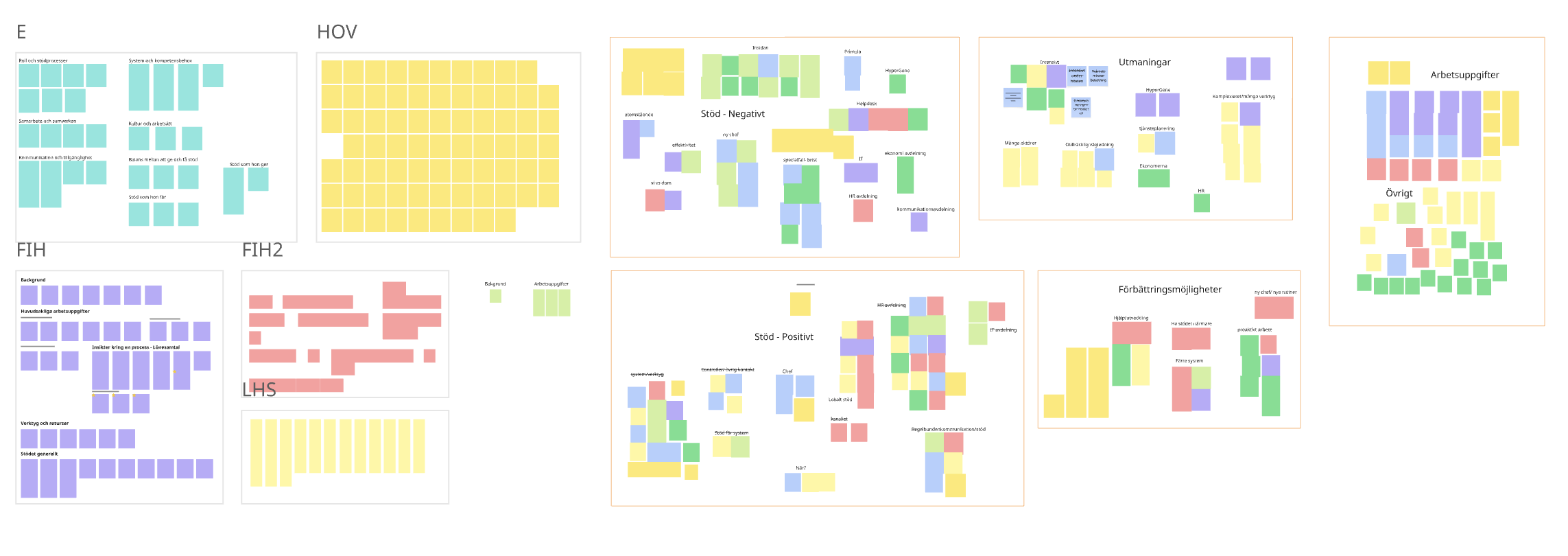
* Thematic analysis of interviews. Interviews were recorded, transcribed and coded on post-it notes in Miro. Decided in themes such as; Improvement opportunities, challenges, work tasks & positive- and negative aspects of the support.

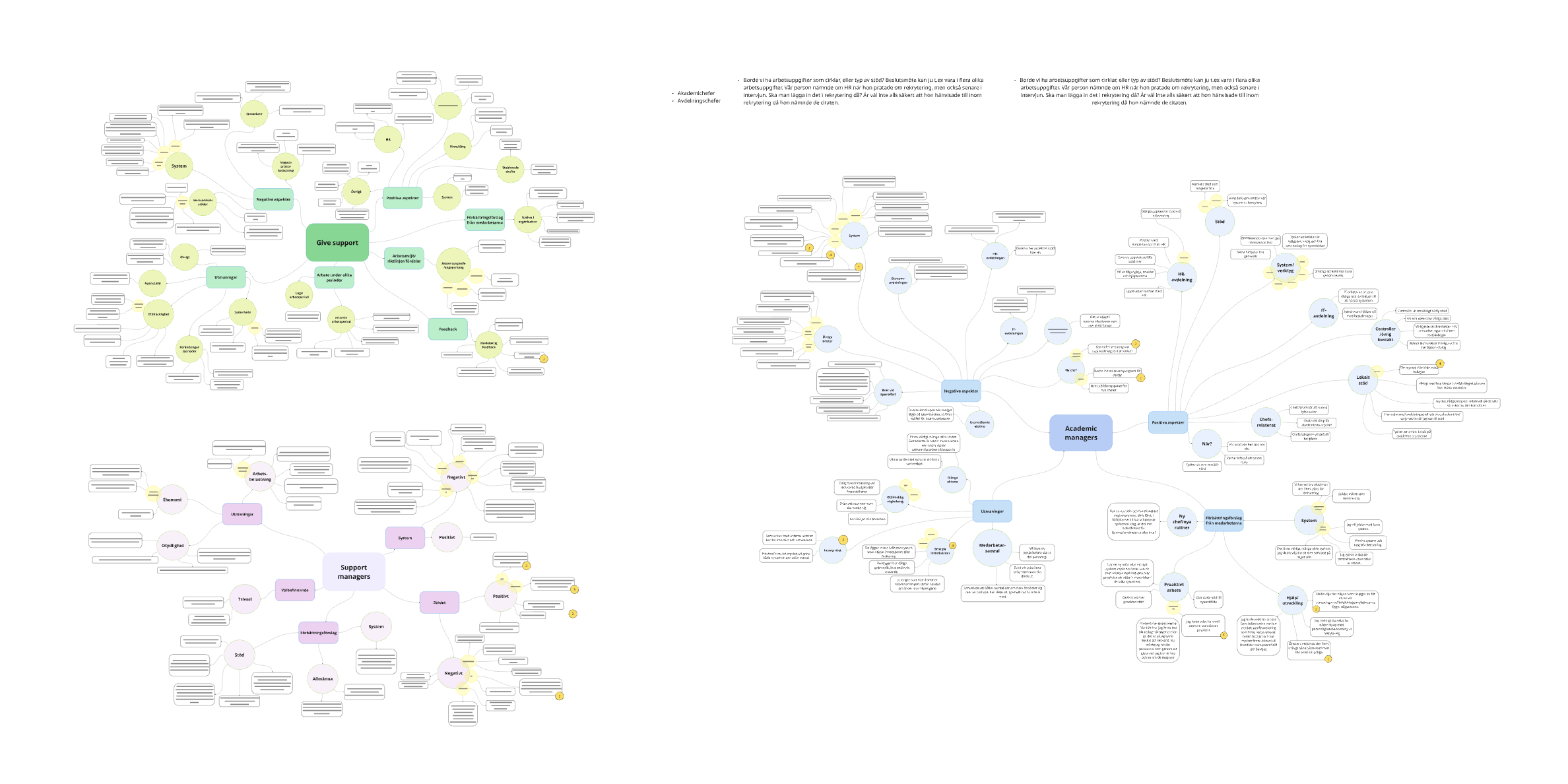
* The interviews also served as the foundation for our "bubble maps". Here we mapped every leading role and their most important aspects of their support needs, such as: Workload, ambiguity, well-being, proactive approach & much more.

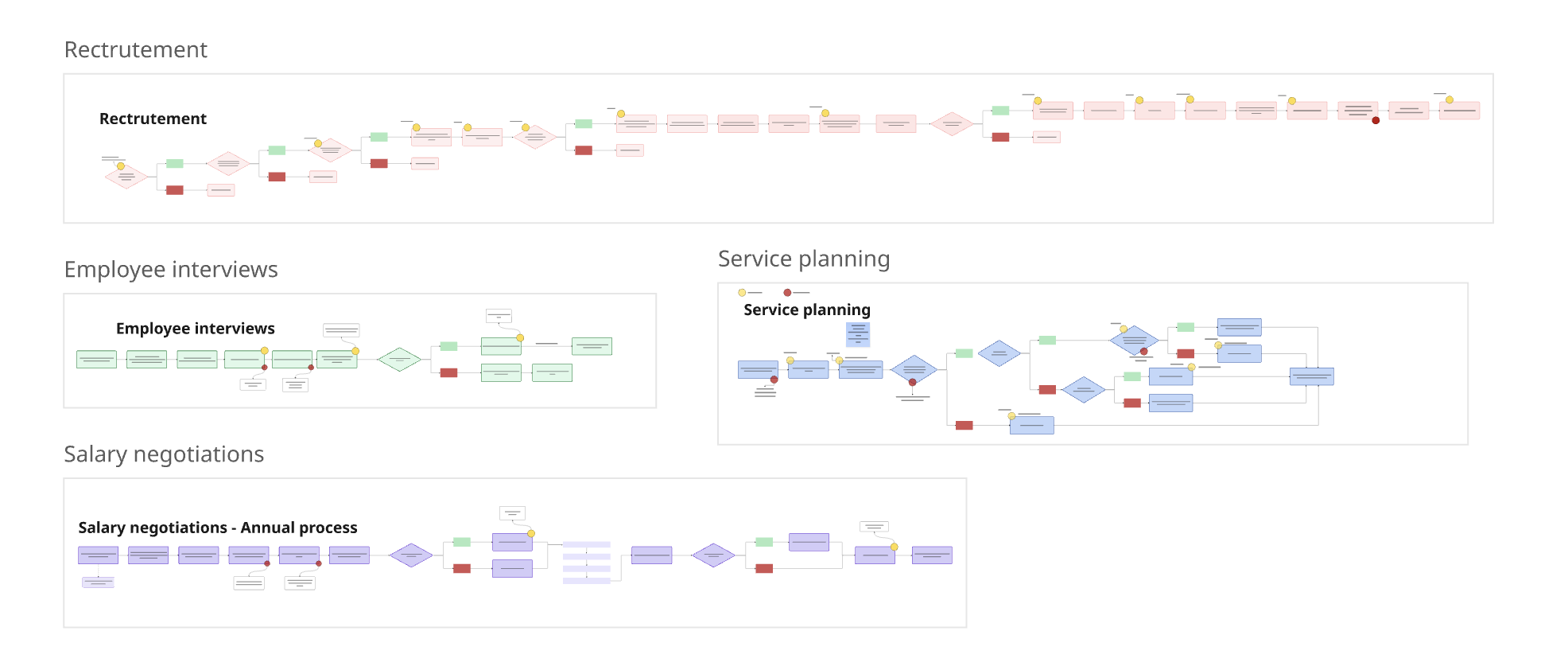
* Customer journey map of complex and time-consuming tasks involving multiple external channels. The red dots represent the pinpoints & the yellow dots represent the need of support.

* Value proposition canvas. Highlighting the alignment between customer (Akademi chefer = academy managers) needs, pains and gains with the product’s features and benefits, such as. It illustrates how the offering creates value and addresses specific challenges for the target users
Long waiting times at the IT department.
The operational support is perceived to work more for its own operations instead of together with the academies
The economy department is perceived by others as slow, but they themself disagree.
Difficult to understand the main informational page, it's perceived as complex and inaccessible.
Lack of support in dealing with discrimination.
Insufficient help with immigration questions.
Unclear expectations between the operational support and academies.
Many systems currently do not work together.

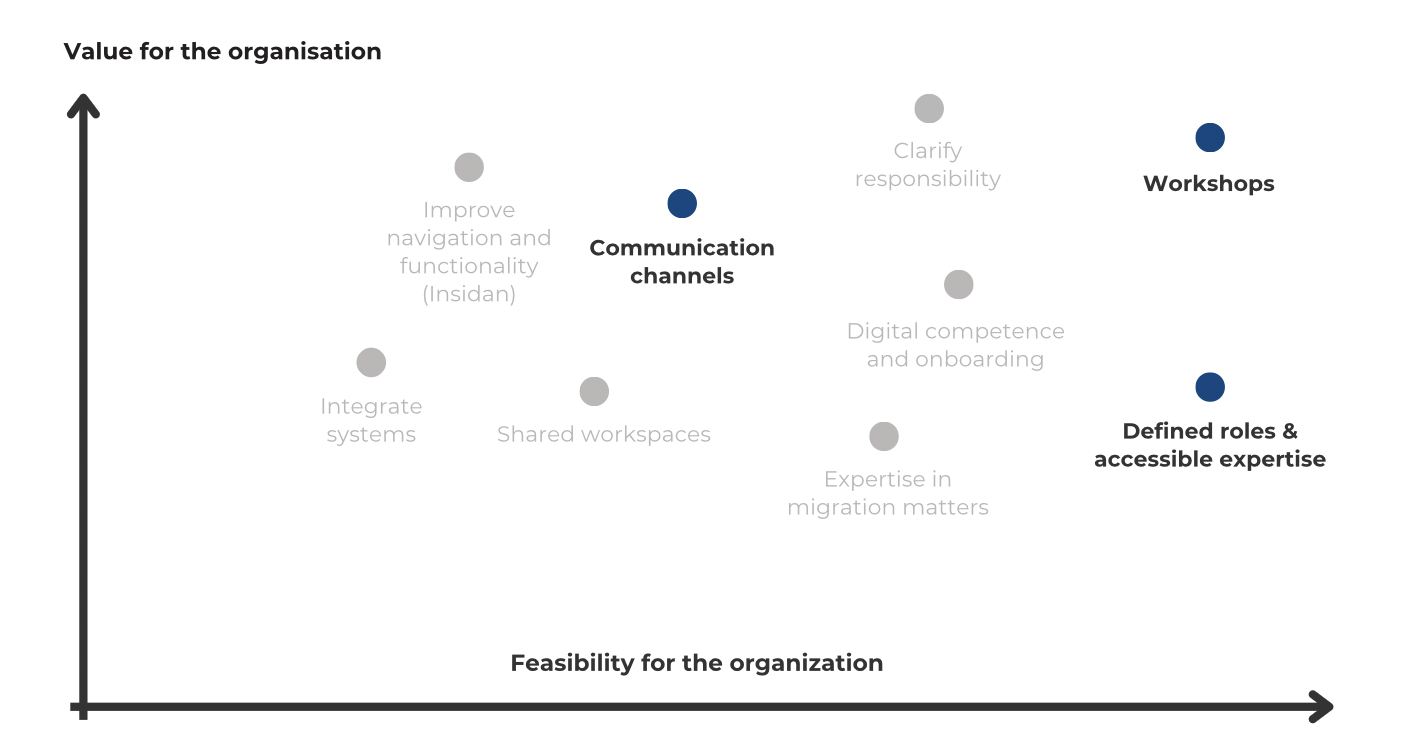
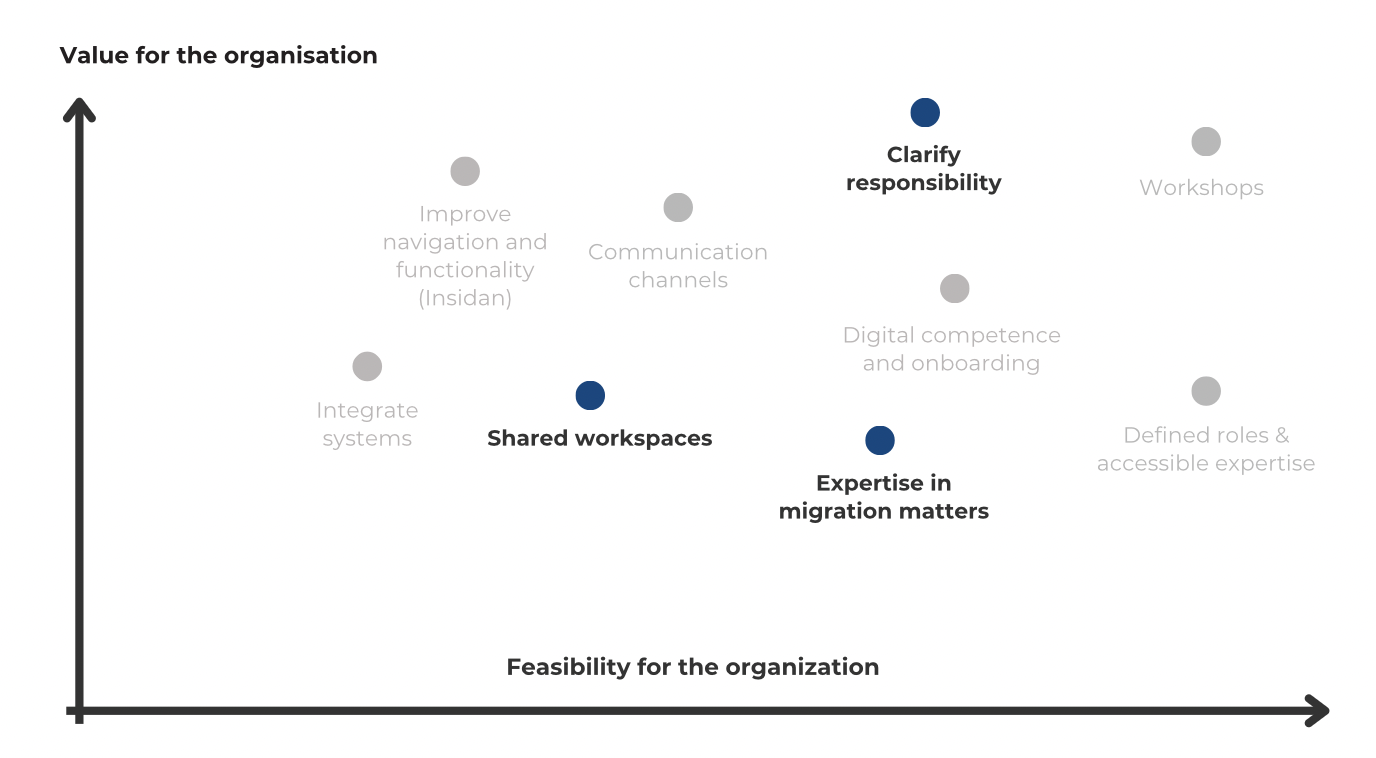
Workshops across the university
To strengthen collaboration, cross-departmental workshops should be introduced to improve mutual understanding and align expectations between support functions and academic units.
Communication channels
Establishing transparent communication routines when decisions affect multiple departments ensures that information flows consistently and prevents misunderstandings.
Defined roles & accessible expertise
Many managers expressed uncertainty about where to turn for help, especially regarding complex issues like migration cases. Appointing a dedicated role for these matters would ensure efficiency and legal accuracy.
Appoint expertise
Introduce a dedicated role or specialist responsible for handling immigration and residence permit issues, ensuring smoother processes and relieving managers from complex administrative tasks.
Shared workspaces
Create shared digital workspaces and define collaboration routines across departments. Assign contact persons within IT and other key support areas to improve accessibility and response times.
Clarify responsibility
Define who handles what in sensitive personnel matters and ensure that HR or other relevant functions are available for emotional and practical support before and after difficult conversations.


Integrate systems
Managers currently have to enter the same information into several platforms. By coordinating and automating data between systems, repetitive tasks can be reduced, allowing time and energy to be redirected toward core responsibilities.
Improve navigation and functionality
The internal platform Insidan was perceived as cluttered, complex and hard to navigate. A redesign focusing on structure, interface clarity, and an improved multilingual search would make information more accessible and decrease dependency on support functions.
Digital competence and onboarding
Many managers lacked proper introductions to key systems such as Hypergene. Targeted training and short tutorials would increase confidence and efficiency in daily system use, enabling smoother workflows and a stronger sense of control.


I am very proud of my team in this project and I have grown so much, both as a designer, researcher but also as a person.
When the project was finished I got the amazing opportunity to present our finding at the Management meeting to the chancellor, department heads and other influential senior management at Halmstad university. They expressed strong appreciation for the thorough mapping and data collection, noting that the insights would actively inform discussions on improving organizational processes and overall effectiveness.
I am very happy with my contribution and proud that I can provide valuable information for further improvement of the school that I absolutely love!